
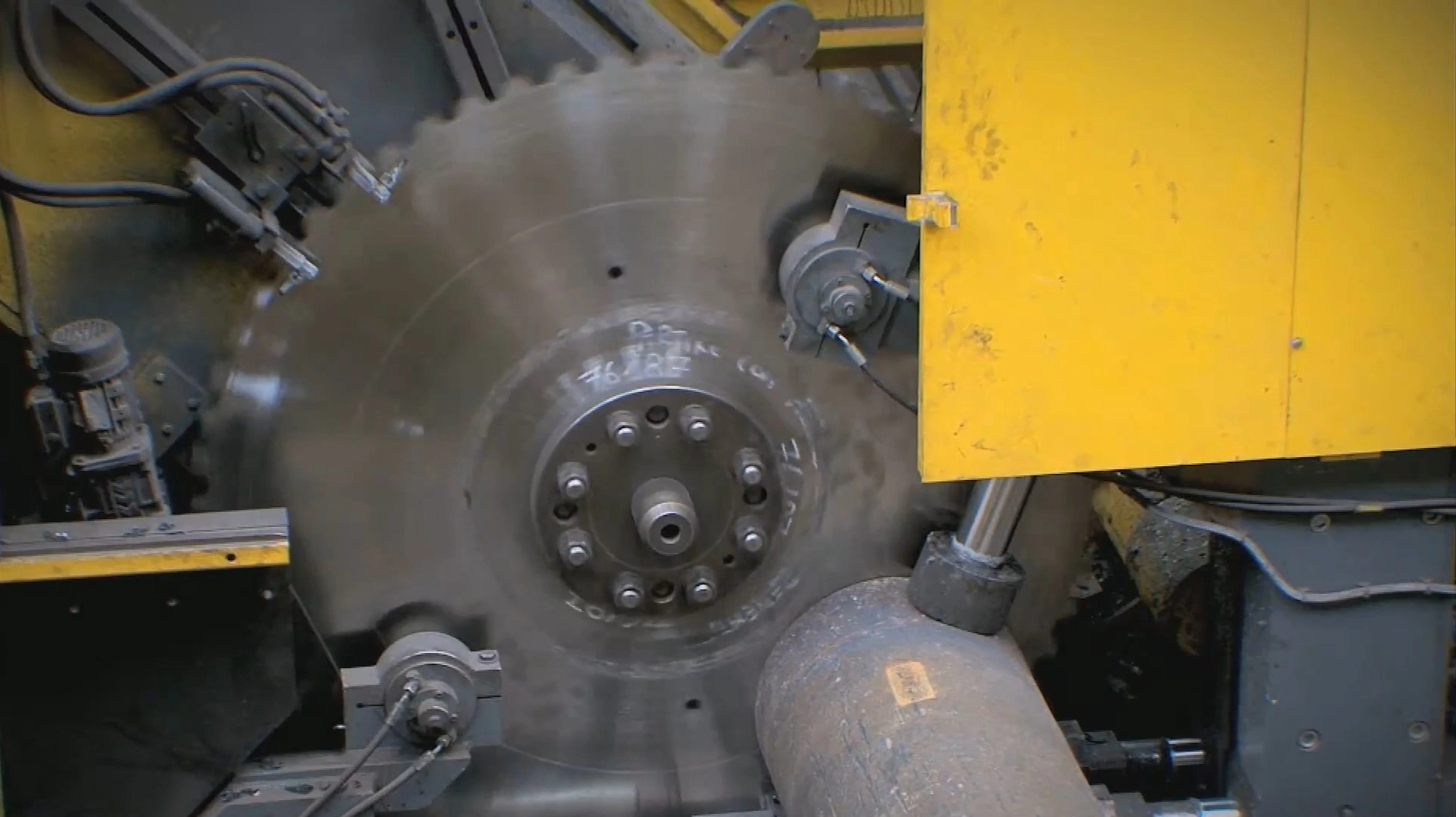
Heavy Billet Cut-off Solutions
Cut Solid Billet at the Pace of the Mill. Precision at Massive Scale.
Engineered for heavy-duty cold saws — Linsinger, SMS group, and similar lines — running blade diameters from 500 mm to 2000 mm. High-tempo continuous rolling mills, and forging lines can't wait on the cut-off. Our heavy-duty TCT circular saw blades exist for one purpose: to part massive solid billet at maximum feed rate, with perfect perpendicularity, without becoming the bottleneck in your line.
Industry Challenges
The Physics of Deep, Solid Cross-Section Cutting
Parting a large solid section on a continuous line is a brutal physical test. Every day, mainstream brazed-carbide giant saw blades fight these three problems.
Maximum Feed, Maximum Load
To keep pace with a continuous line, the saw blade has to hold an aggressive feed rate straight through a large solid section. That means absorbing enormous cutting force and clearing a torrent of chips every second of the cut — sustained load that will stall the cut or break down any blade not engineered to take it.
Deep-Hole Chip Evacuation & Seizing
The single worst failure mode in solid cutting. As the saw blade buries deep into the billet, each chip must travel a long way inside a closed kerf before it can escape. The moment evacuation chokes, the chips swell and pack — instantly seizing the saw blade, chipping the carbide, or even warping the steel body.
Deflection & Runout at Massive Diameter
A 1.5 m blade carries an 8 mm body weighing over 100 kg, yet under immense cutting force and centrifugal load it still wants to vibrate and wander laterally. Any runout destroys the perpendicularity of the billet face — and that error feeds straight into the precision forging or machining that follows.
Our Technical Approach
How We Keep a Giant Saw Blade Stable at Full Feed
Dynamic Plate Tensioning for Maximum Rigidity
To beat runout, every 500–2000 mm body is precision roll-tensioned to a tight dynamic specification. The saw blade stays dead flat and rigid even at full rotational speed and under thermal expansion, holding the perpendicularity error on the billet face to an absolute minimum.
Aggressive Chip-Splitting Geometry
For solid cutting we run a complex tooth form with dedicated chipbreakers that force one wide, solid chip to fracture into two or three narrow ribbons. That eliminates the chip swelling and packing that seizes the body in a deep kerf, and keeps the cut flowing smoothly all the way through.
The PVD & Logistics Alternative — Replaceable Inserts
Brazed TCT remains the all-round strongest mainstream choice, but a giant saw blade is too large to fit a vacuum chamber for PVD coating. For customers chasing maximum single-edge life on abrasive steel, or facing costly cross-border resharpen logistics, we offer a replaceable-insert option: PVD-coated inserts bolted to the body and changed on the machine.
Product Ecosystem
Heavy Metallurgy Tooling Matrix
Brazed-carbide saw blades for solid billet and rail steel, plus a replaceable-insert option where coating and resharpen logistics matter most — all from 500 to 2000 mm.
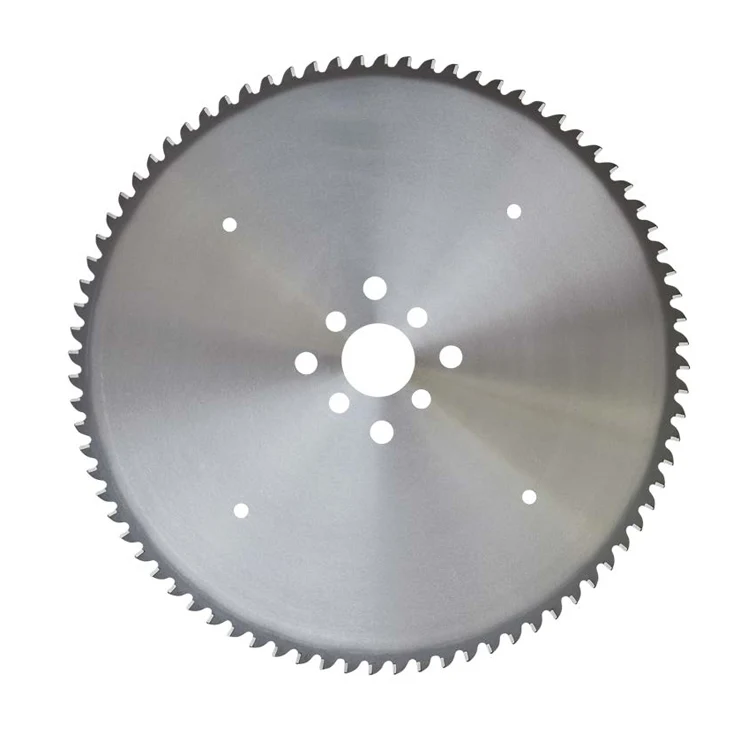
Brazed TCT · 500–2000 mm
Cold Saw Blades for Steel Billet
Large-diameter carbide cold saw blades for the head-and-tail cropping and cut-to-length of solid carbon, alloy, and stainless billet on the rolling line. A dynamically tensioned body and chip-splitting tooth deliver square, perpendicular faces at the feed rate a continuous mill demands.
Solid steel billet · rolling & forging lines
View specifications →
Brazed TCT · 500–2000 mm
Cold Saw Blades for Rail & Wheel Billet
A carbide grade and tooth geometry tuned for the high-carbon, high-hardness steel of rail and wheel billet. Built to hold perpendicularity and a clean cut face through the most abrasive heats feeding rail rolling and wheel forging.
High-carbon rail steel & wheel billet
View specifications →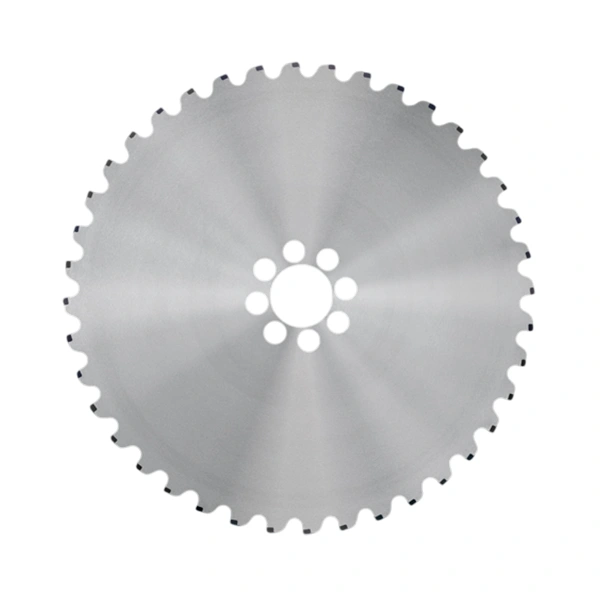
Replaceable-Insert · 500–2000 mm
Inserted-Tooth Cold Saw Blades for Rail & Wheel Billet
Mechanically clamped, PVD-coated carbide inserts for the most abrasive rail and wheel steel. Coating only possible on small independent inserts maximizes single-edge life, and worn inserts are changed on the machine — no shipping a 100 kg blade back for resharpening. A wider kerf is the trade-off.
Abrasive rail / wheel steel · long resharpen logistics
View specifications →Expected Outcomes
What This Saw Blade Program Delivers
The gains a rolling, forging, or rail line can expect when a giant saw blade is matched to the section, the steel grade, and the tempo of the cut.
Extreme feed rates and reliable chip evacuation let the saw keep pace with a continuous forging or rolling line, so the cut-off never holds up the high-value process feeding it.
Roll-tensioned bodies hold their flatness under huge feed force, delivering the perpendicular billet faces that downstream precision forging and machining depend on.
Chip-splitting geometry and — where it counts — PVD-coated replaceable inserts stretch service life and cut the number of saw blade changes, taking cost and downtime out of every campaign.
Expert FAQ
Selection & Process Diagnostics
What determines the largest solid billet a saw blade can part in one cut?
It comes down to geometry. The usable cut depth is roughly the saw blade radius minus the radius of the clamping flange and a safe overrun. As a rough guide, a 1500 mm saw blade parts solid sections in the 400–500 mm range; for larger billet you step up the diameter, which is exactly why these saws run saw blades to 2000 mm. Tell us your maximum section and we’ll match the diameter, body thickness, and tooth count.
How do you solve chip clogging when a 1.5 m saw blade cuts through a 400 mm solid billet?
Deep-hole chip evacuation is solved in the tooth geometry. We run specific multi-step chip splitters on the carbide tips. Instead of one wide, curling chip that expands and jams the kerf, the teeth shear the metal into narrower, segmented chips that flush easily out of the gullet before they can generate friction or seize the saw blade body.
When should we choose the replaceable-insert saw blade over a conventional brazed TCT saw blade?
Brazed TCT is the mainstream workhorse — narrower kerf, less material loss, and outstanding overall stability. Only consider the replaceable-insert option if (1) you’re cutting extremely abrasive steel where a PVD coating, possible only on small independent inserts, is essential for tool life, or (2) your plant is far from any resharpening center, making it too expensive and frustrating to ship a 100 kg giant saw blade back and forth. Remember the insert design needs a slightly wider kerf, so you lose marginally more material per cut.
We’re losing perpendicularity on rail billet cuts — is it the machine or the saw blade?
On a giant saw blade in solid high-carbon steel this is almost always lateral deflection, not a feed-axis fault. Either the chip is packing in the kerf and pushing the body sideways, or the body has lost tension and can no longer resist the cutting load. Our saw blades address both: chip-splitting geometry keeps the gullet clear, and tight dynamic roll-tensioning holds the body flat and rigid under full feed force so the face stays square.
Do we need a different saw blade for high-carbon rail and wheel steel than for ordinary billet?
Yes. Rail and wheel billet is markedly harder and more abrasive than commodity carbon billet, so it wears edges faster and demands a tougher carbide grade and a tooth geometry tuned for that load. We supply a dedicated rail-and-wheel brazed saw blade for it, and for the most abrasive heats a PVD-coated replaceable-insert version that maximizes single-edge life and lets you change inserts on the machine.
Get a Cutting Plan
The saw should never be the bottleneck in your line
Tell us your billet section and steel grade, your saw model and saw blade diameter, and your perpendicularity target — and our engineers will recommend the body, carbide grade, and tooth geometry that keeps your rolling, forging, or rail line moving.