
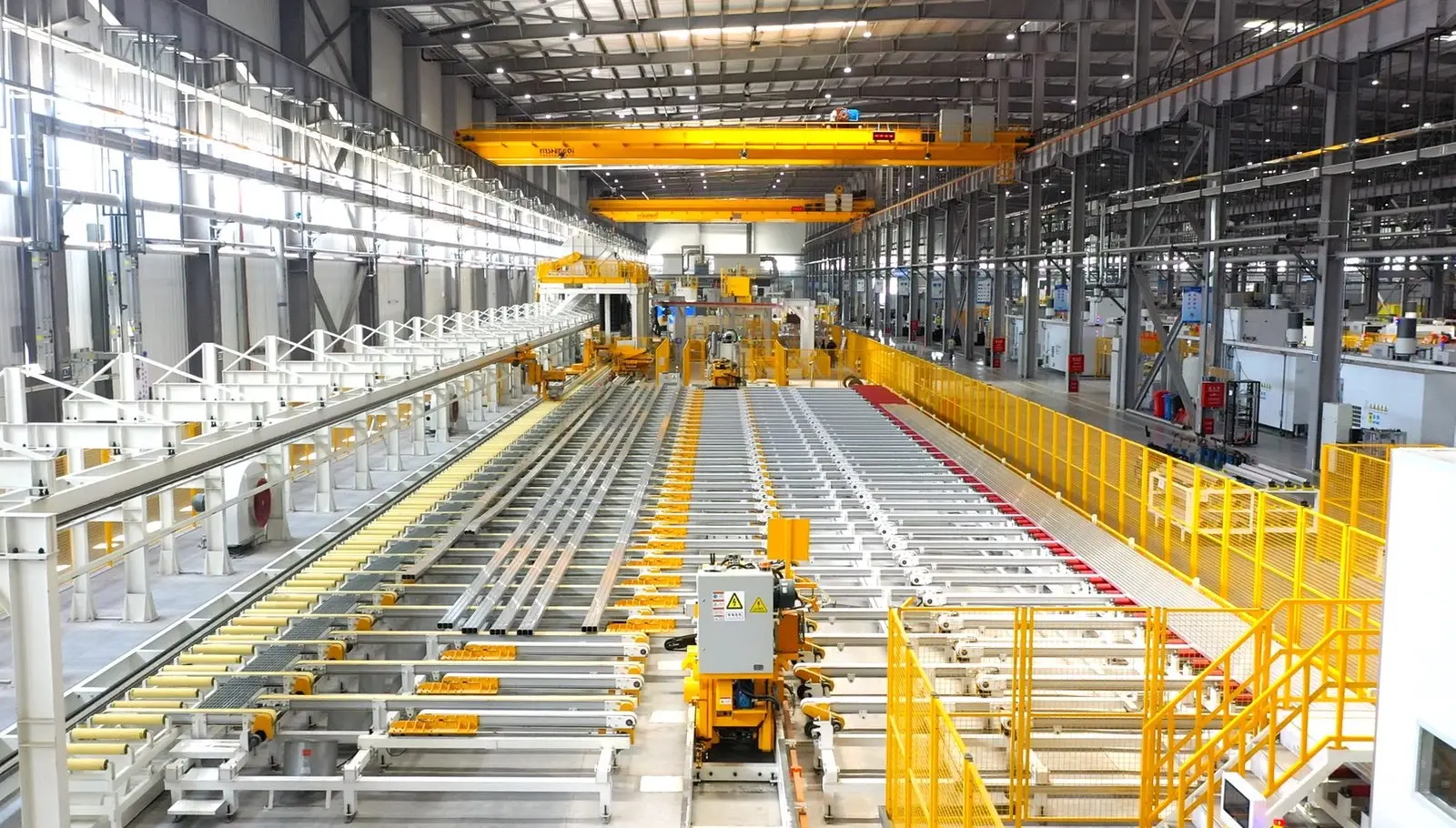
Aluminum Extrusion Plant Solutions
Full-Line Aluminum Extrusion Sawing Solutions
From cast billet to finished profile — engineered for thermal stability, low-deflection precision, and relentless continuous operation across cold billets, hot billets, and profiles cutting, so your automated line runs with longer saw blade life and minimal downtime.
Industry Challenges
Four Sawing Pain Points Across an Extrusion Plant
Aluminum extrusion spans a huge gap, from rough casting to precision forming. Each cutting station faces a completely different physical problem — these are the four we engineer against.
Thermal Shock & Body Fatigue in Hot Billet Sawing
Ahead of the press, billets are sawn at 400–500 °C. The heat creates the internal stress in saw blade body, so it loses tension in an instant and develops dangerous fluttering and twisting at full rotational speed.
Inclusions & Abrasive Wear in Cast Billet Sawing
The ends of a freshly cast billet are full of hard spots, alumina (Al₂O₃) inclusions, and slag. Cropping them is effectively micro-grinding: these abrasive non-metallics shred the carbide rake face, collapse ordinary blade life, and overload the saw motor.
Burrs & Deformation in Thin-Wall Profile Cutting
Extruded sections are complex, with walls thinner than 1 mm. If cutting resistance is too high or the tip is not sharp enough, the action degrades from clean shearing into punching and tearing — collapsing thin walls and leaving stubborn burrs that demand costly secondary deburring.
Built-Up Edge in Solid Cold Billet Cutting
Cold-cutting solid 6000- and 7000-series billet creates huge, continuous cutting resistance. Heat and pressure at the tip cold-weld softened aluminum to the carbide, forming a built-up edge. Once the gullets pack with swarf, the blade jams in the kerf and can damage the saw driveline.
Our Technical Approach
Hard-Engineered Answers to Each Failure Mode
Thermal-Shock-Resistant Sub-Micron Carbide & Tri-Metal Brazing
Defeats hot-cut chipping and fatigue. For hot sawing we use sub-micron carbide with a precisely tuned cobalt content to raise fracture toughness and absorb thermal shock, brazed with a silver–copper–silver tri-metal shim that holds at 500 °C and forms a micro shock-absorbing buffer between tip and body.
High-Positive Rake & Modified TCG for Burr-Free Shearing
Defeats profile burrs and wall deformation. For thin-wall sections we run an aggressive 10° positive rake with a razor-honed modified triple-chip grind (TCG). The geometry shears rather than smashes the aluminum, releasing cutting force along the ideal vector for a clean, deformation-free, burr-free cut.
FEA-Optimized 80CrV2 Body with Thermal Compensation
Defeats body flutter and loss of tension at temperature. Large-diameter saw blades (500–1500 mm) for cold and hot billet use a high-rigidity 80CrV2 body. FEA computes centrifugal force and thermal expansion to place expansion slots and noise‑reducing slots, then senior technicians dynamic roll-tension each blade to lock deformation inside tight tolerances.
Ultra-Fine Ground Rake Face & Chip-Flow Gullets
Defeats built‑up edge and ensures reliable chip evacuation. Deep, fluid‑dynamic gullets replace standard pockets, and the rake face is micro‑ground with high‑grit diamond wheels to a mirror finish. The ultra‑low‑friction surface ejects each chip as it curls, preventing cold welding on cast or solid aluminum billet.
Recommended Tooling
Matched Saw Blades for Every Station
Each cutting station has its own physics — and its own dedicated circular saw blade.
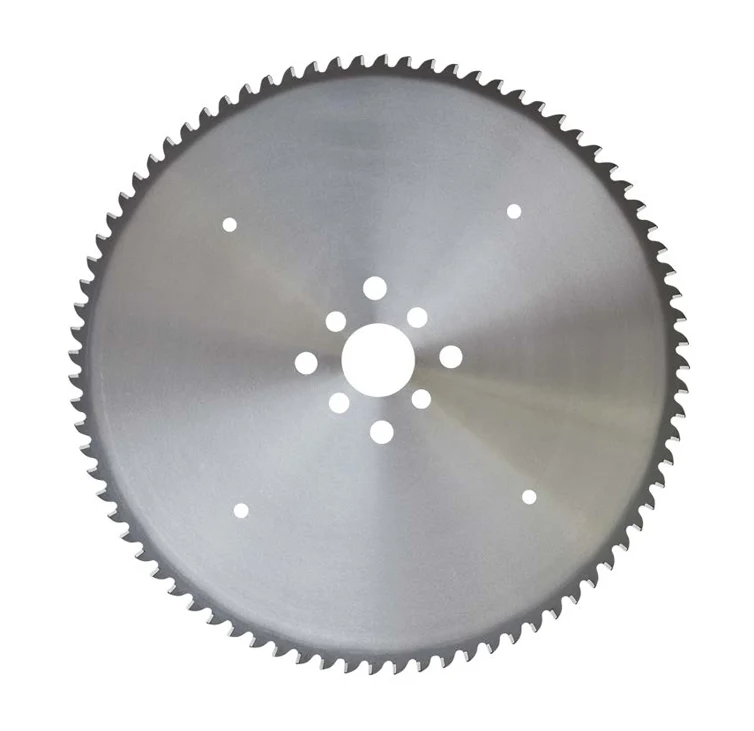
Casthouse / Billet Casting
Large Circular Saw Blades for Aluminum Ingots & Billets
TCT blades for cropping and cut-to-length of freshly cast aluminum billets, logs, and ingots — built to survive the oxide inclusions and hard spots at the cast ends.
View specifications →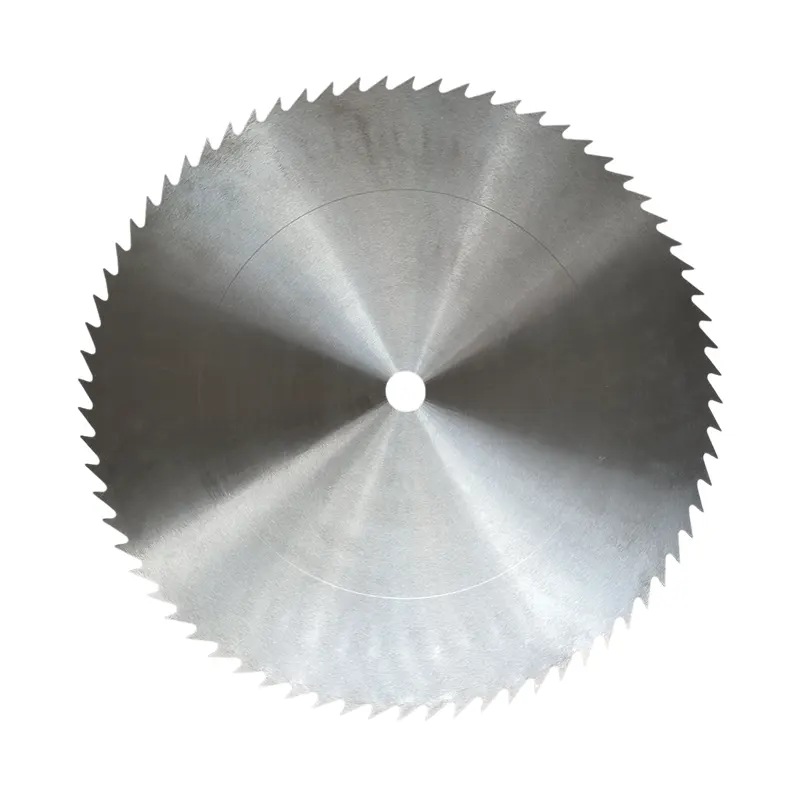
Casthouse / Low-Speed Saws
Tool Steel Circular Saw Blades for Aluminum Billet
An economical 75Cr1 tool-steel saw blade for cold-cutting aluminum billet on low-speed radial-arm and pendulum saws — a budget option for lower-volume shops, not carbide-tipped.
View specifications →Pre-Extrusion / Hot Sawing
Large Circular Saw Blades for Hot Aluminum Billets
Engineered for billets heated to 400–500 °C ahead of the press: high-rigidity 80CrV2 body, FEA-positioned expansion slots, and dynamic roll-tensioning to stop hot deflection.
View specifications →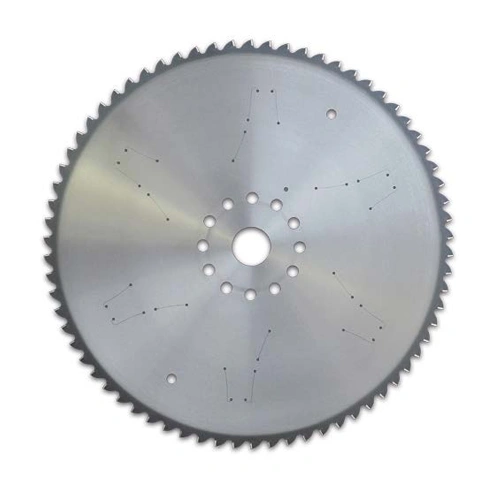
Post-Extrusion / Cut-to-Length
Large Circular Saw Blades for Aluminum Extrusion Profiles
TCT blades for cutting complex thin-wall and heavy-wall extruded profiles to length — high positive rake and razor-sharp TCG geometry for burr-free, deformation-free cuts.
View specifications →Expected Outcomes
What This Tooling Program Delivers
Industry-typical gains when an extrusion plant standardizes on the right saw blade for each station and our recommended cutting parameters.
Anti-stick and thermal-shock designs extend mean time between resharpening (MTBR) by 30–50%, keeping the press running at full load around the clock with fewer blade changes.
Clean shearing on thin-wall profiles eliminates secondary deburring on the great majority of cuts, taking real labor cost out of every shift.
A locked-down body holds cut length and squareness within strict tolerances during hot and cold sawing, so downstream stations and saw automation stay fed without rejects.
Expert FAQ
Frequently Asked Questions
Can one saw blade be used for both hot‑billet and cold‑billet cutting?
No. Hot‑saw blades are factory‑tensioned to operate at temperatures of 400 °C and above. Used cold, that tension profile no longer matches the load path through a solid, high‑strength billet, which results in uneven cut faces. Conversely, a cold‑cut blade loses plate stiffness as soon as it thermally expands in a hot‑sawing environment. Each process requires a blade designed and tensioned specifically for that temperature range.
Why are we suddenly getting severe burrs on thin-wall extrusions?
Thin‑wall burrs typically come from one of three mechanical issues: (1) the tooth pitch is too coarse, leaving fewer than three teeth engaged and allowing the section to tear; (2) spindle runout has drifted out of tolerance, causing sidewall contact; or (3) the rake edge has developed micro‑wear. Verify the pitch‑to‑wall‑thickness ratio, or use a higher‑tooth‑count blade sized specifically for thin‑wall profiles.
How do your saw blades handle hard oxide inclusions in unrefined cast billet?
Increasing carbide hardness alone is not effective, because oxide inclusions impose high‑energy impact loads at the billet head. Our design uses a wider carbide tip to increase braze‑joint strength and a more impact‑tolerant, slightly blunted cutting angle. This sacrifices a small amount of surface finish but significantly improves survival in severe inclusion conditions. For extreme cases, special‑grade carbide tips are available.
We only run a low-volume, low-speed billet saw — do we need carbide?
Not necessarily. On low‑speed radial‑arm or pendulum saws, a 75Cr1 tool‑steel billet saw blade can cold‑cut aluminum billets at much lower cost than a carbide‑tipped saw blade and can be resharpened many times. It is not suitable for high‑speed automated lines, but for low‑output operations where cost matters more than throughput, it is an appropriate choice.
Get a Cutting Plan
An extrusion press making scrap is the most expensive machine in your plant
Stop accepting burrs, blade deflection, and excessive kerf loss as normal. Send your billet dimensions and extrusion alloys to our technical engineers for a data-driven tooling upgrade.