Typical Applications
- Cut-to-length of hot aluminum extrusion billets (logs) heated to 400–500 °C before they are loaded into the extrusion press.
- Hot log and billet sawing on extrusion-line log saws and cut-off systems, where billets are sawn to charge length and fed straight into the press.
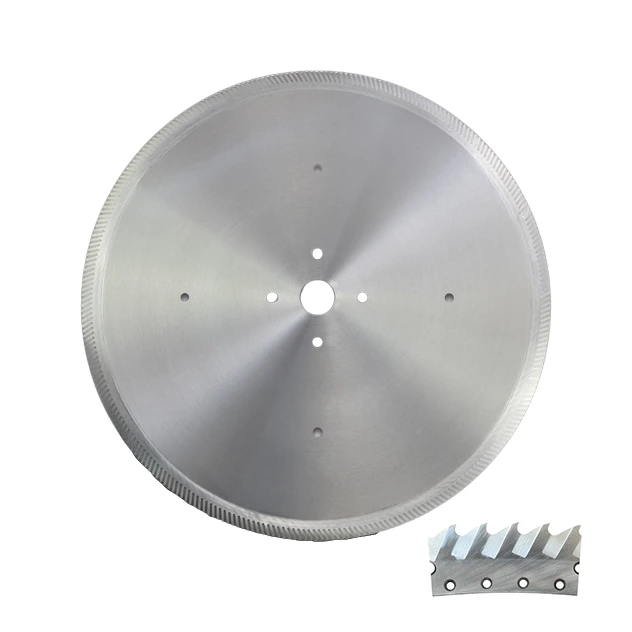
- Cold cutting of solid aluminum billets, logs, and large round bars where a rigid, low-distortion circular saw blade body is required.
- Retrofit and replacement circular saw blade projects for billet saws and log saws on extrusion presses supplied by companies such as SMS, DANIELI, UBE, COMETAL, and SINOMACH.
Problems This Circular Saw Blade Helps Solve
- The dangerous “fluttering” and twisting that occurs when a conventional circular saw blade body releases its internal stress against a hot billet and instantly loses tension at high rotational speed.
- Saw blade wandering and out-of-tolerance cut faces caused by thermal expansion and centrifugal force acting on a large-diameter body.
- Aluminum build-up (“aluminum sticking”) when softened, near-molten aluminum welds to the teeth and body at 400–500 °C.
- Short circular saw blade life and unstable cut accuracy in continuous extrusion-line production.
Engineered for Hot Billet Sawing
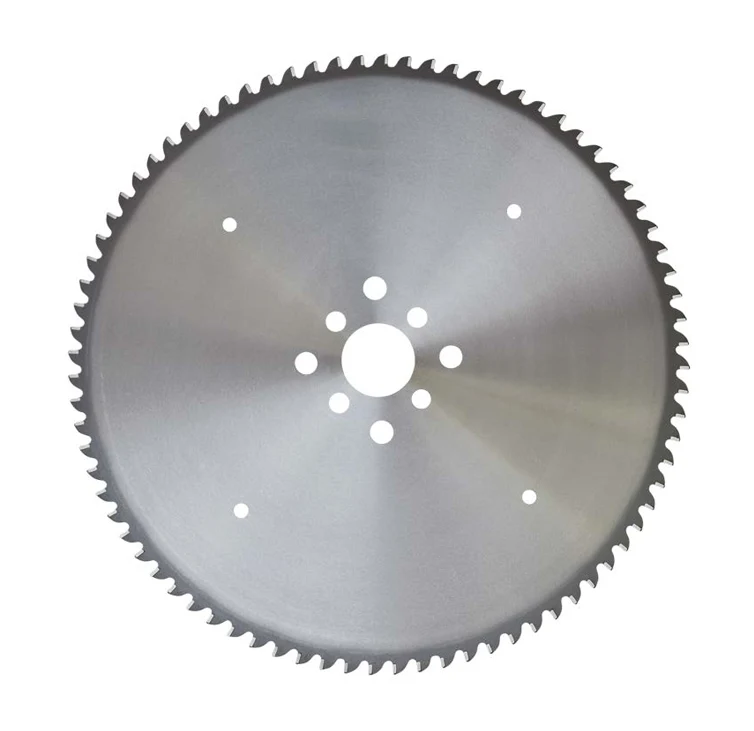
- High-rigidity 80CrV2 tool-steel body sized for large-diameter (roughly 500–1500 mm) circular saw blades for solid aluminum billet, suitable for both hot and cold cutting.
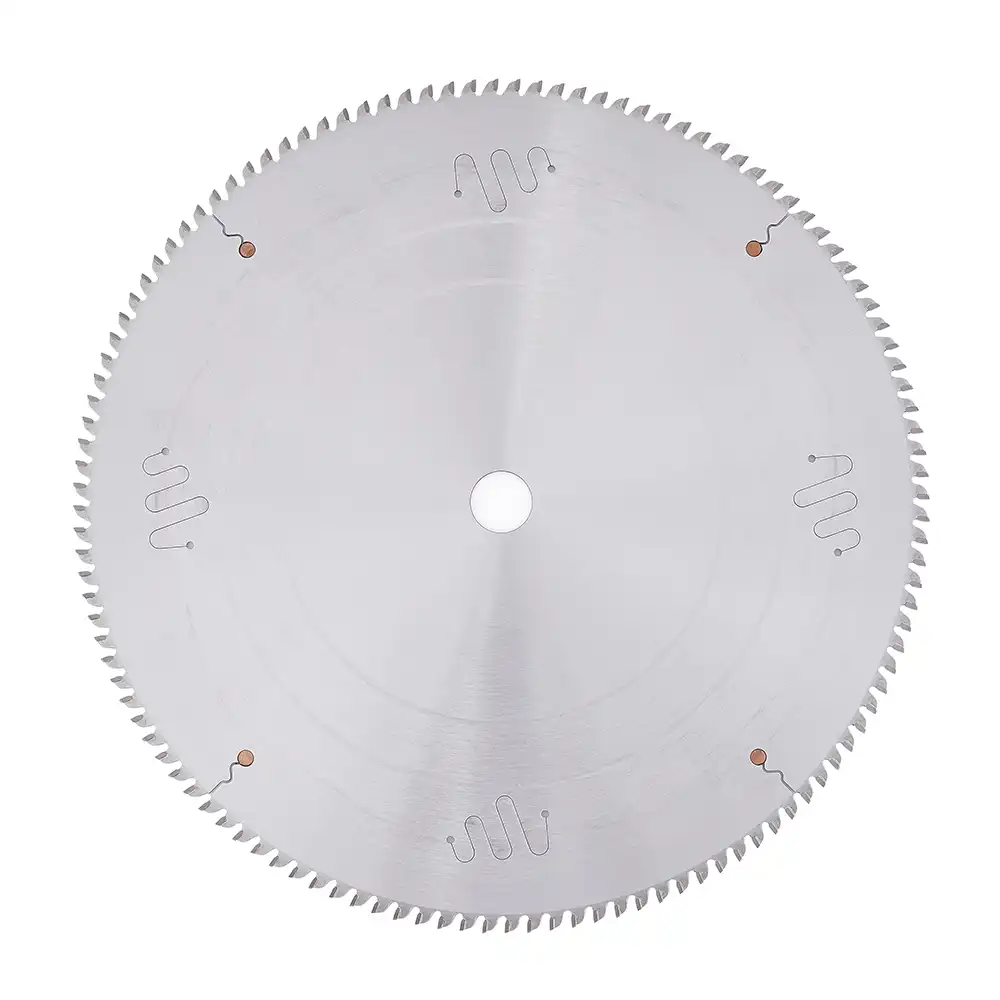
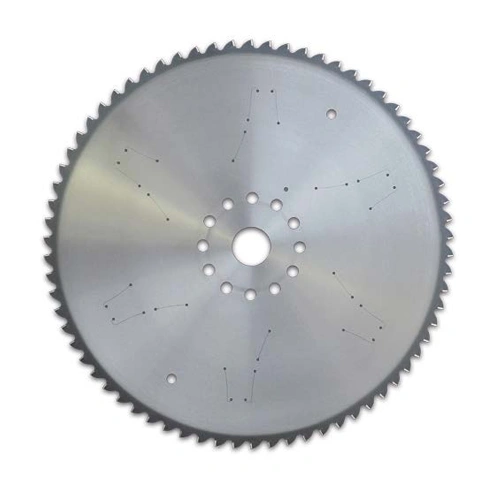
- Finite element analysis (FEA) is used to calculate centrifugal force and thermal expansion, so expansion slots and noise-damping slots are positioned for each diameter and operating temperature.
- Dynamic roll-tensioning performed by senior tensioning technicians locks body deformation within strict tolerances under high temperature and heavy cutting resistance.
- Tooth geometry, carbide grade, kerf, and hook angle are matched to the alloy and billet diameter for clean, low-burr end faces.
Application Notes
- Use a minimum-quantity lubrication (MQL) system to atomize the lubricating oil and spray it precisely onto the circular saw blade; this lubricates the cut and prevents hot aluminum from welding to the teeth and body (“aluminum sticking”).
- Keep clamping rigid, feed stable, and the saw well aligned, especially on large-diameter hot log saws.
- Match tooth count, hook angle, and peripheral speed to the billet diameter, alloy type, and target production rate.
- For replacement projects on extrusion-line billet and log saws, confirm saw type, circular saw blade diameter, bore, clamping method, and drive power before final circular saw blade design.
- Clean and resharpen the circular saw blade in time to maintain cut flatness, dimensional consistency, and predictable circular saw blade life in continuous production.