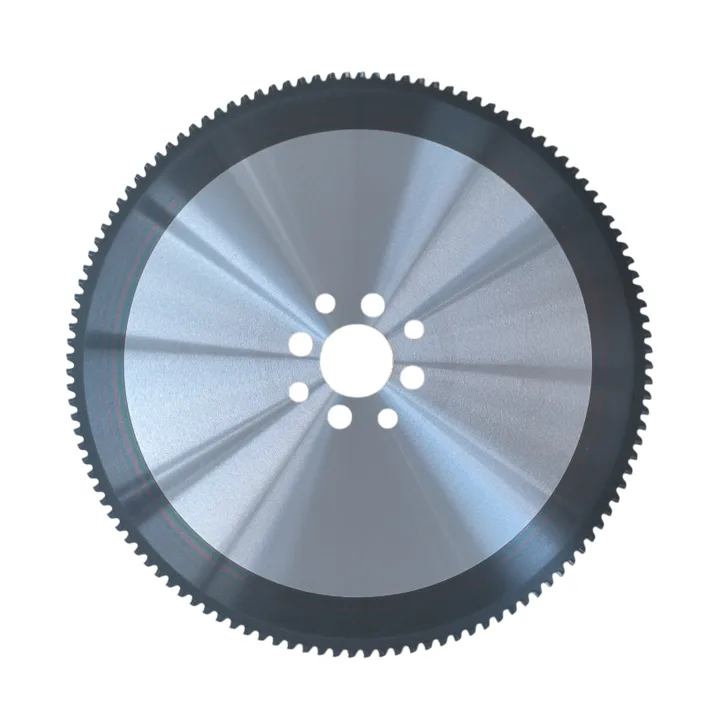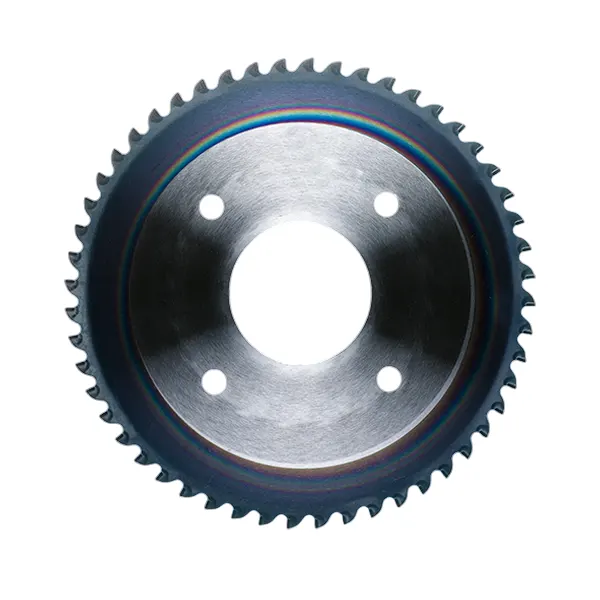
Typical Applications
- Billet preparation on railway rail production lines: cutting rail steel billet to specified lengths before the hot rolling process—head cropping to remove defective ends, tail cropping, and precision cut-to-length in a single cold sawing operation prior to furnace charging and rolling.
- Billet preparation on steel wheel production lines: cutting wheel billet to weight-controlled lengths before the hot forming and roll-pressing process—accurate billet weight is critical to final wheel geometry and dimensional consistency.
- High-volume billet cutting operations where minimising total tooling cost and maintenance downtime is a priority alongside consistent cut quality and predictable cold saw blade service life.
Key Performance Advantages
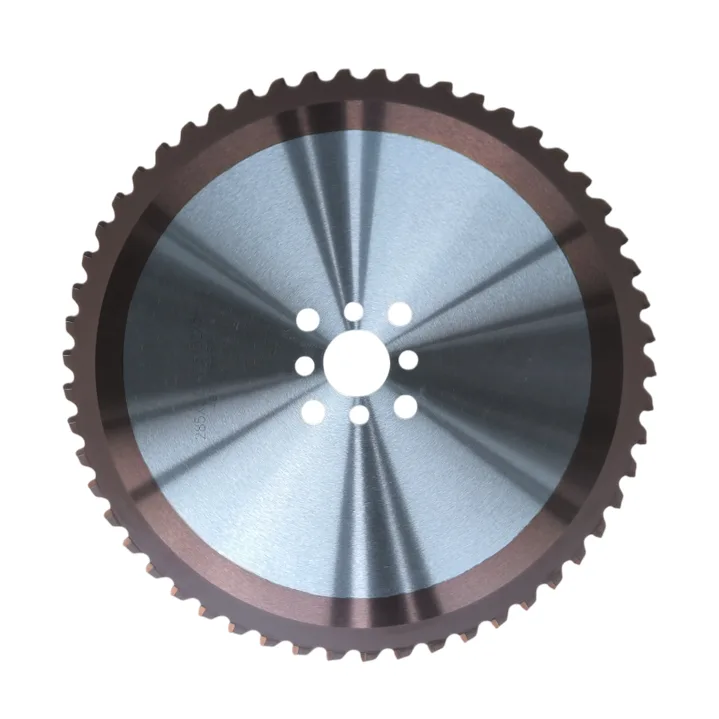
- PVD-coated carbide inserts: the coating increases insert hardness and reduces friction at the cutting edge, extending insert service life beyond that of uncoated brazed-tip cold saw blades on high-carbon rail and wheel steels.
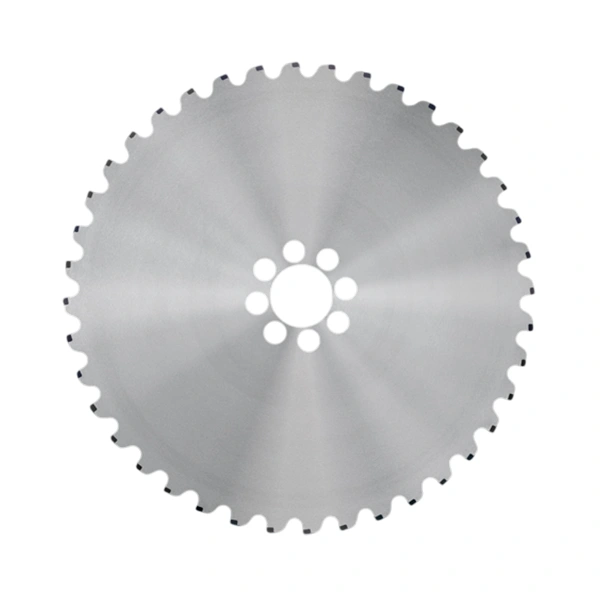
- On-site insert replacement: when inserts reach end of life, they are unscrewed and replaced on the production floor—no need to return the blade body to the manufacturer for re-tipping. Replacement requires only a screwdriver, not brazing or specialist tooling.
- Lower maintenance cost: only the inserts need to be ordered and replaced, not the entire cold saw blade. The blade body remains in service for multiple insert cycles, significantly reducing total tooling cost per tonne of billet cut.
- High cut length accuracy: cold sawing produces flat, square cut faces with tight length tolerances—critical for rail production where billet length directly controls rolled rail length, and for wheel production where billet volume controls wheel dimensions.
- No heat-affected zone: cold sawing keeps cut zone temperatures low, preserving billet end metallurgy and avoiding surface hardening or decarburisation at the cut face that would affect the subsequent hot rolling or hot forming operation.
Problems This Cold Saw Blade Helps Solve
- High tooling cost per tonne of billet cut when the entire cold saw blade must be returned for re-tipping every time carbide tips wear out—inserted tooth design eliminates this by allowing on-site insert-only replacement.
- Production downtime during blade changeover on high-output rail and wheel billet lines—having spare inserts on hand allows rapid restoration of cutting performance without waiting for blade return and re-tipping.
- Rapid carbide insert wear when cutting high-carbon rail and wheel steel with uncoated general-purpose inserts—PVD coating extends insert life on these hard, demanding materials.
- Poor cut face quality—burr, taper, or material drag—causing billet-end defects that affect downstream rolling or roll-pressing process quality.
Application Notes
- Flood coolant is required—direct adequate coolant flow to the cutting zone to support chip evacuation and control cutting temperatures throughout the cut.
- Confirm cold saw blade diameter, bore diameter, kerf width, and pinhole pattern against machine specifications before ordering; dimensions vary across billet cold saw models and billet cross-section size ranges.
- Replacement inserts are available separately. Contact us to confirm the correct insert specification for your blade body.
- Cold saw blade and insert specifications can be customised to billet steel grade, cross-section diameter or side length, and machine type. Contact us with your application requirements.