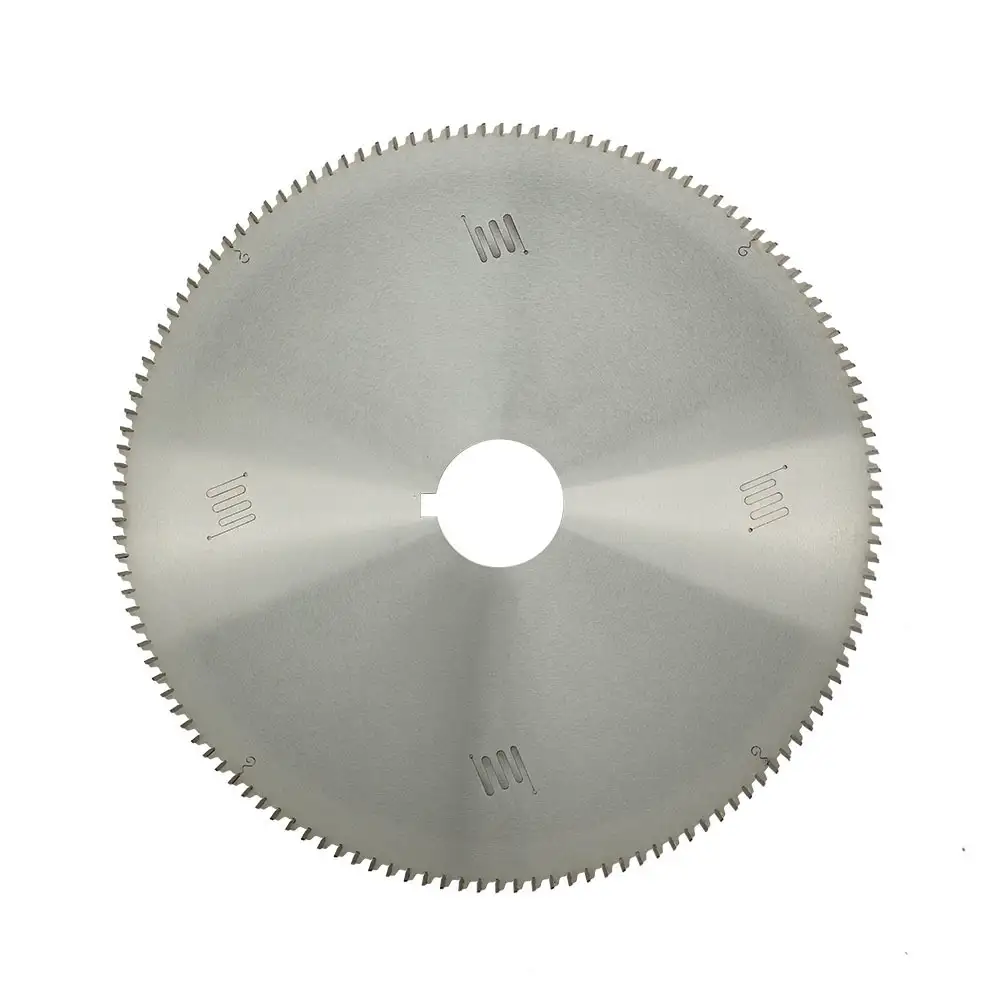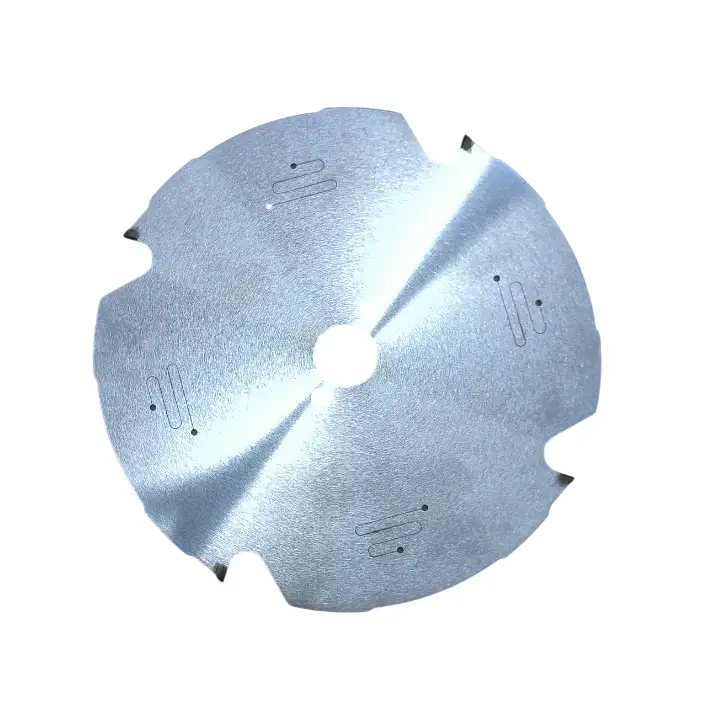
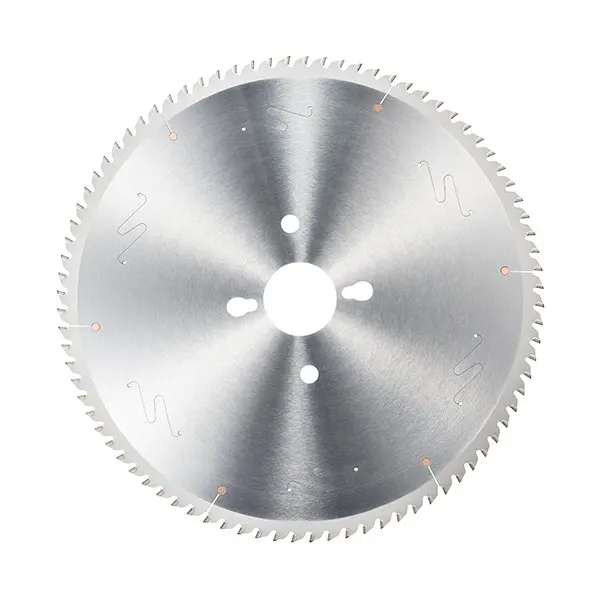
Typical Applications
- High-volume factory production cutting of calcium silicate board and fibre cement board, where saw blade wear rate and production continuity directly affect manufacturing cost per square metre.
- Industrial lines producing plasterboard and magnesium oxide board panels to standard dimensions, where consistent cut quality and minimum saw blade changeover time are essential to meeting output targets.
- Factory fabrication of phenolic resin board, compact laminate board (HPL), lab-grade phenolic board, engineered marble, and Corian, where the hard or abrasive material composition makes standard carbide saw blade life too short for viable production economics.
- Any composite building board production environment where tooling cost, machine uptime, and cut quality consistency are measured and managed as part of factory operating costs.
PCD Tip Technology
- PCD stands for Polycrystalline Diamond.
- In this circular saw blade design, the complete tooth material combines Polycrystalline Diamond with a tungsten carbide substrate.
- Calcium silicate board and fibre cement board are among the most abrasive building materials in factory production. Their high silica, calcium silicate, and mineral fibre content rapidly wears standard tungsten carbide tips, often within hundreds to low thousands of linear metres. PCD cutting edges resist this abrasion by an order of magnitude.
- The result is a saw blade that maintains a consistent, sharp cutting geometry for tens of thousands of linear metres, sustaining cut quality, dimensional accuracy, and production efficiency throughout long production runs without the cost of frequent saw blade changes.
Key Performance Advantages
- Blade lifespan typically 10x or more longer than standard carbide alternatives on calcium silicate board and similar mineral-rich composite boards, directly reducing saw blade cost per square metre of material processed. Actual lifespan depends on board material, grade, and cutting parameters.
- Fewer production stoppages for saw blade changes means higher machine uptime, better output continuity, and more predictable production scheduling—improving overall factory cutting efficiency.
- Consistent cut edge quality from the start of a production run to the end: no mid-run quality drift from progressive blade dulling that forces re-inspection, re-cutting, or rejection of finished panels.
- Lower dust and silica particle output during cutting compared to working with a worn carbide saw blade, improving factory air quality and reducing health compliance risk.
- PCD blades can be professionally resharpened multiple times before replacement, extending service life further and reducing the true cost-per-use over the saw blade’s full lifecycle.
- A single PCD circular saw blade investment replaces many carbide blades over the same production volume, simplifying saw blade inventory, reducing procurement frequency, and lowering total tooling spend.
Problems This Circular Saw Blade Helps Solve
- Rapid and unpredictable carbide saw blade wear when cutting calcium silicate board, fibre cement, or magnesium oxide board in factory production, making saw blade cost per unit of output high and maintenance hard to plan.
- Unplanned production stoppages for mid-run saw blade changes that disrupt output schedules, increase labor cost, and reduce machine utilization.
- Progressive cut quality degradation as carbide tips wear during a production run, leading to dimensional variation, edge chipping, or finished panel rejection.
- High cumulative tooling spend in facilities that process large volumes of abrasive composite building boards with standard carbide blades.
- Silica and mineral dust generation during cutting of calcium silicate board, fibre cement, and similar boards, creating occupational health concerns and factory environment compliance requirements.
Application Notes
- This circular saw blade is designed for factory and industrial machine environments: sliding table saws, panel sizing saws, horizontal saws, and automated cutting lines used in composite building board production.
- Calcium silicate board and fibre cement board are the primary target materials. The saw blade also performs effectively on magnesium oxide board, plasterboard, engineered marble, phenolic resin board, HPL, lab-grade phenolic board, and Corian under appropriate cutting parameters.
- Optimize spindle speed, feed rate, and cutting depth to the specific board type and thickness. Harder, denser materials such as engineered marble and lab-grade phenolic board may require lower feed rates than lighter plasterboard.
- Keep machine spindle runout, arbor accuracy, and saw blade flange condition within tight tolerances. Even small runout increases edge load unevenly across PCD tips and shortens saw blade life.
- Implement dust extraction at the cutting zone to manage silica and mineral particle output when processing calcium silicate board, fibre cement, and similar mineral-based boards.
- Schedule saw blade resharpening through a qualified service provider before the cutting edge fully dulls—resharpening a saw blade in good condition costs less and recovers more service life than waiting until the edge is heavily worn.
- Maintain a rotation of blades so a sharpened replacement is always on hand, eliminating production stoppages while a saw blade is away for resharpening.