· Cutek Team · Buying Guides · 5 min read
TCT vs. HSS Saw Blades: 5 Critical Differences Every Procurement Manager Must Know
A practical, no-nonsense comparison of HSS and TCT circular saw blade technologies—covering material, heat resistance, linear cutting speed, machine rigidity, and lifecycle cost—to help procurement managers source the right blade.

When sourcing tooling for a metal fabrication shop or a tube mill, the choice of a circular saw blade fundamentally dictates your production tempo, cut quality, and long-term operating cost. For procurement managers and process engineers, the tooling decision almost always narrows down to two dominant material technologies: HSS (High-Speed Steel) and TCT (Tungsten Carbide Tipped).
Specifying the wrong blade does not just lead to premature tool failure—it can trigger production bottlenecks that cost thousands of dollars per hour. Before you issue your next purchase order, you need to understand the physical and mechanical differences between these two cutting technologies. Here are the 5 critical differences to weigh when choosing an industrial circular saw blade.
1. Material Composition: Solid Steel vs. Brazed Tips
The most fundamental difference lies in how each blade is built.
- HSS (High-Speed Steel): An HSS saw blade is a monolithic tool. The entire blade—from the center bore to the cutting teeth—is machined from a single piece of high-alloy tool steel (typically M2/DMo5, or M35/Co5 alloyed with cobalt). The teeth are ground directly into the solid steel body.
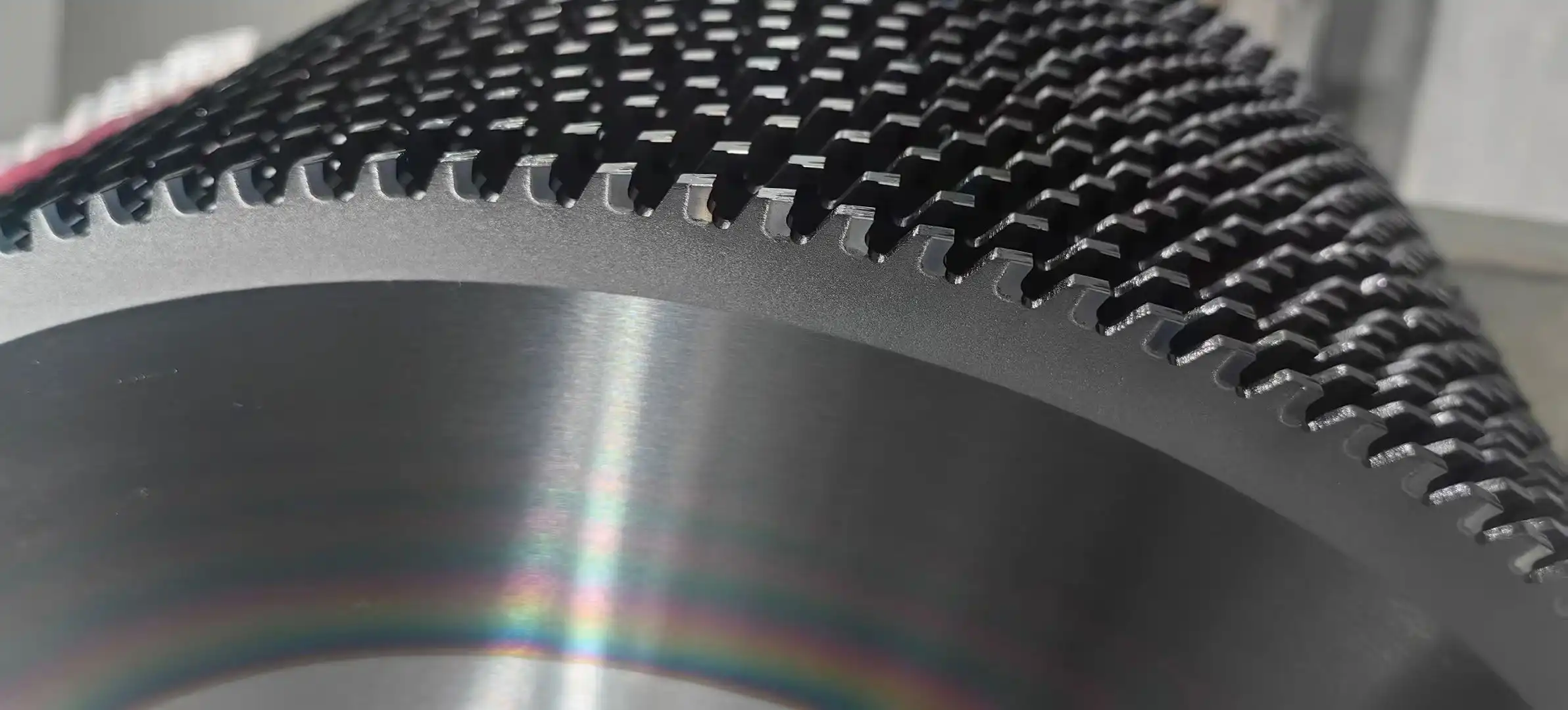
- TCT (Tungsten Carbide Tipped): A TCT saw blade is a composite tool. The body plate is made from a tough carbon steel (such as 80CrV2), while the cutting teeth are individual tungsten carbide or cermet inserts brazed onto the plate. Carbide is exceptionally hard and wear-resistant, but it is also far more brittle than solid high-speed steel.
2. Heat Resistance and Thermal Stability
Friction generates intense heat during metal cutting, and the thermal threshold of your circular saw blade governs how aggressive your feed rates can be.
- HSS thermal limit: Standard HSS begins to lose its hardness once the cutting zone exceeds roughly 550–600 °C. Because of this lower tolerance, HSS sawing relies on abundant flood coolant to stop the teeth from softening and dulling.
- TCT thermal limit: Tungsten carbide tips hold their hardness and cutting edge at far higher temperatures, often in the 850–900 °C range. This heat resistance lets a TCT circular saw blade perform high-speed dry cutting or run on minimal quantity lubrication (MQL) without degrading the teeth.
3. Cutting Speed (Linear Velocity)
To make an apples-to-apples comparison, we evaluate linear cutting speed (meters per minute, m/min) rather than spindle RPM, because RPM swings drastically with blade diameter. The figures below are based specifically on cutting carbon steel tube.
- HSS speed on steel: Limited by heat, an HSS circular saw blade typically cuts carbon steel tube at a conservative 30–90 m/min. On a 275 mm blade, that works out to roughly 35–100 RPM.
- TCT speed on steel: A TCT saw blade cutting the same carbon steel tube runs at 150–400 m/min, with the top end common on high-speed flying cut-off tube mills. This lets modern lines hit far shorter cycle times.
- Material context matters: Cutting speed depends entirely on the workpiece. The numbers above are for carbon steel tube only. A non-ferrous TCT circular saw blade cutting aluminum extrusion can easily run at 2,000–4,000 m/min—roughly ten times the steel figure.
4. Machine Rigidity and Vibration Absorption
You cannot bolt a high-speed blade onto an unsuitable machine. The rigidity of your saw decides which circular saw blade you can safely run.
- HSS (high shock resistance): HSS is inherently tough and slightly flexible, so it absorbs mechanical shock and vibration well. When you cut thin-walled structural tube, run a low-speed manual cold saw, or work an ERW tube mill where the internal weld scarf is not fully removed, an HSS blade flexes, takes the impact, and keeps cutting without shattering.
- TCT (low shock resistance): Carbide teeth are extremely hard but brittle. They demand rigid, servo-driven cold saws with near-zero spindle runout. Heavy vibration or a sudden hard impact—such as bouncing over an uncut inner weld seam—will micro-chip or shatter the tips, ruining an expensive blade in seconds.
5. Resharpening Cycles and Lifecycle Cost
The purchase price and the true cost-per-cut differ sharply between the two.
- HSS resharpening: Because the teeth are part of the solid body, an HSS circular saw blade can be reground on CNC grinders roughly 10–15 times before the diameter shrinks too far to use. Paired with a lower purchase price, HSS is economical for low-to-medium volumes and abrasive jobs.
- TCT resharpening: A TCT saw blade costs more up front, and the brazed tip can only be reground about 5–8 times before the carbide is ground away. However, with its long edge life and cutting speeds several times faster than HSS, the TCT blade delivers a lower cost-per-cut in high-volume continuous production.
Summary Comparison
| Technical Feature | HSS Circular Saw Blade | TCT Circular Saw Blade |
|---|---|---|
| Material structure | Solid high-speed steel (monolithic) | Alloy steel body with brazed carbide tips |
| Max heat tolerance | ~550–600 °C | ~850–900 °C |
| Steel cutting speed | 30–90 m/min | 150–400 m/min |
| Aluminum cutting speed | Not suited to high-speed non-ferrous | 2,000–4,000 m/min (≈10× steel) |
| Machine requirement | Tolerates vibration; fits manual/auto saws | Needs high rigidity, servo drive, zero runout |
| Resharpening cycles | 10–15 times | 5–8 times |
| Ideal application | Thin-walled tube, older machines, shock loads | High-speed cutting, solid bar, burr-free finish |
Final Verdict
Neither technology is universally “better”—it comes down to matching the tool to the application. If your shop runs low-speed machinery, cuts unstable thin-walled steel tube, or fights heavy vibration that breaks teeth, a quality HSS circular saw blade is the safest and most economical choice. But if you run a rigid, high-speed automated line and need maximum throughput with burr-free finishes on solid billet or welded and seamless tube, a premium TCT circular saw blade is the only way to keep your sawing station from becoming the bottleneck.